Archive for June, 2008

New York City Freebie: “Today Show” Summer Concerts & Coldplay

Friday, June 27th, 2008

Hello Cheapos!

New York City is full of freebies — especially during the summer. From free IKEA sunset cruises to the Bryant Park film series, there’s an endless variety of free activities.

One well-known freebie that we’d never experienced is the Today Show’s “Summer Concert Series” at Rockefeller Center. During the summer months, world-famous singers perform free outdoor concerts on Friday mornings. Thousands of tourists show up each week, but we’d always stayed away.

It always seemed like a big deal: wake up before 6 a.m., take the subway all the way to Rockefeller Center (these Cheapos live in Brooklyn), stand in a crazed crowd, listen to a couple of songs, and then battle the multitudes down into the subway. Why not just watch it on TV?

Well, this morning we woke up and decided to go for it. We looked at the schedule earlier in the week and noticed that Coldplay, possibly our favorite band, was set to perform at 8:30. So, we hopped on the train at 6:15 a.m. and hoped for the best.

As expected, it was insane. The crowds were thick (some fans slept overnight in order to score a spot close to the stage, while others camped out inside a nearby Dean and Deluca coffee shop), helicopters were flying overhead, and it somehow was already 80 degrees Fahrenheit and humid.

But before this we could say “I need another coffee,” Coldplay took the stage and all was forgiven. Fans were clapping. Al Roker (the Today Show’s affable weatherman) was singing. Double-decker tour buses were driving by, their normally-seated passengers erupting into dance party mode. We were still sweating, but didn’t mind. After all, this was summer in New York and we were seeing Coldplay for free. Viva les Cheapos!

The photos above and below were all taken by the two Cheapos who attended the show (there is a full album on the EuroCheapo Facebook page).

Other upcoming performers appearing later this summer include Boy George (July 7), Miley Cyrus (July 25), and Paula Abdul (August 29). See the Today Show’s website for full details.

Chris Martin loves you.

Sorry \'bout the crop, Chris!

Coldplay fans at 30 Rock.

Popularity: 21% [?]

A Cheapo tour of Valencia, Spain

Thursday, June 26th, 2008

The coastal city of Valencia, the third largest locale in Spain, is an ideal destination for a long, relaxing weekend or an action-packed adventure. We asked Heather Cowper, travel blogger extraordinaire, how to make Valencia a cheapo-friendly spot. Here, her insight for an inexpensive getaway:

Cheapo activities in Valencia-

Head to the Mercado Central: The main fruit and vegetable market in Valencia is a feast for the eyes and a great place to buy all the makings for a picnic—saving the cost of lunch in a café. The building itself is airy and light with colorful tiles and stained glass windows. Don’t forget to check out the amazing fish section at the far end of the market. It’s a true treat and a fantastic way to see real deal Spanish seafood.

Linger at La Lonja: The 15th-century silk exchange is a Unesco World Heritage site and has been recently restored. The entry is free. Follow along the colonnaded hall with its twisting stone columns and cathedral-like atmosphere. Next, walk through the shady courtyard decked in orange trees. Finally, go up the steps to the upper room with its beautiful coffered ceiling. The whole experience will make a lasting, and cheap, impression.

Go to Plaza de la Virgen: This plaza is a pleasant place to sit with a drink, admire the fountain, or eat a picnic. If you want to visit the Cathedral, it will normally cost you €4 including an audio-guide. But, if you attend one of the many masses, you can enter for free. Try the Sunday 9:30 a.m. mass held in the Chapel of the Holy Grail where you can hear the Gregorian chant as a bonus.

Walk through Turia Gardens: The Turia River flowed through Valencia until it was diverted in the 1950s due to flooding. Today’s picturesque riverbed is a series of public parks. Do as the locals do and take an afternoon stroll or have a picnic there. The area around the Palau de la Musica is especially pleasant.

Don’t leave without… 

Getting your architecture fix. You can’t leave Valencia without stopping to admire the amazing architecture of the town’s museums, cinemas, and concert halls. Sure, the venues are expensive, but it costs nothing to wander around and look. Take in the buildings, cool blue pools, and metal sculptures in the gardens. And, be sure to pop into the shady botanical greenhouse, L’Umbracle.

Finding a free museum. There are many great museums in Valencia where average prices are about €2-3 for entrance. However, the Museo de Bellas Artes, the Bullfighting Museum, Museo Historico Municipal, and Museo de Prehistoria (also known as La Beneficienca), are free. The Palacio del Marques de dos Aguas, which contains the Ceramics Museum, is free on Saturday afternoon and Sunday too—and is well worth a visit.

Basking at the beach. If the sun is shining, take a bus or tram to the port of Valencia, which hosted the America’s Cup last year. Then move on to the beach and wander along the boardwalk, relax on the sand, or go for a swim. If you want to sample some authentic Paella, a traditional Valencia dish, you can try it in one of the many restaurants along this strip.

Dining tips-

Have a gourmet lunch on a budget. For a delicious 3-course lunch at only €9, head to the ground floor restaurant in the free Museo de Prehistoria, known as La Beneficienca. Service starts at 2 p.m., but arrive a little earlier for a drink in the shaded courtyard, also popular with the locals.

For nightlife-

Check out Barrio Carmen: If it’s nightlife you’re after, head for Barrio Carmen. By day, it’s the sleepy old quarter of the city replete with hip and trendy shops. After 10 p.m., it comes alive with bars, restaurants, and nightclubs—and the party goes on until dawn! Make sure you check out the incredible graffiti-art on surrounding walls.

About the author: Heather Cowper is the author of the well-known travel blog, “Heather On Her Travels“. She lives in Bristol (United Kingdom).

Popularity: 19% [?]

France Night Train Alert: €15 couchettes through July 14

Wednesday, June 25th, 2008

Nicky and Susanne of hidden europe magazine posted on our blog last week about the joys of night trains in Europe. Today, they came across a Cheapo-friendly night train offer from TGV, the French railway: 

When we wrote last week’s post, we assumed that First Scotrail’s Caledonian Sleeper services (nightly from London Euston to over forty destinations in Scotland) was Europe’s best overnight rail travel deal. Just £19 one way in the comfort of a sleeping car, if you are lucky to get one of the cheapest tickets.

But now the French railways have come up with an even better deal for the summer: €15 one way overnight on French night trains. Okay, not quite the comfort of the Caledonian Sleeper, but in a couchette.

The fare can be booked until July 14, and is valid for travel on Monday, Tuesday, Wednesday and Thursday nights until August 28, 2008. It applies on selected internal French routes using Lunea and Corail night trains.

Book on the official TGV website. If the €15 fare is sold out, you’ll be offered the next available fare (€25 and up).

Thanks for the tip, Nicky and Susanne!
Find more travel tips and stories on less-traveled destinations in
hidden europe magazine.

Popularity: 18% [?]

Nice: The “Nice Riviera Pass” debuts. Should you hop on the bus?

Tuesday, June 24th, 2008

The Nice Visitors Bureau just announced the debut of their new visitor’s pass, labeled the Nice “Riviera Pass”. Is it a good deal? It depends on your trip plans. Here’s a quick overview:

The pass: The Nice “Riviera Pass” is a tourist pass that grants holders free entry into a number of the area’s attractions, as well as numerous discounts throughout the region.

What you get: Free admission to nine major sights in Nice, Antibes, Biot, Cagnes-sur-mer, and Monaco. Sights include the National Museum of Marc Chagall (Musée Chagall) and Marineland (for the 72-hour pass), the Musée Renoir, and the Musée national Fernand Leger.

Extras: The pass also includes a 60-page guidebook, unlimited transportation on the Nice “Le Grand Tour” double-decker buses (which stop at most of Nice’s main attractions and includes multi-language commentary), free daily guided tours of major sights like the Nice opera house and Castle Hill (Monday through Friday in French only, Saturdays in French and English), and discounts at dozens of restaurants, shops, and area attractions.

What it costs: The Nice Riviera Pass is offered for 24-hours (€24), 48-hours (€36), or 72-hours (€54). The pass is equipped with a “smart chip” that starts keeping time from the moment you validate it. Free entry into museums and other sights is valid for the duration of the pass, while other discounts (for restaurants, shopping, and leisure activities) are valid for one month.

How to buy it: You will soon be able to an purchase the card online. For now, buy it in person at the Nice Visitor’s Bureau, of which the main offices is at 5, Promenade des Anglais. Check out their website for more information.

The verdict: As we’d suggest with any city pass, price out your trip itinerary and compare it to the cost of the pass. (Conveniently, the card’s website shows you standard ticket prices for these attractions, making it easy to tally up.) If you’re already planning to head to the sights covered by the card, the pass will let you skip lines and bounce around town on a cute bus. It will also take you to places in Nice that you might otherwise ignore.

If, however, your plans in Nice mostly involve a beach towel, an umbrella, and a cool drink, you might “pass” on this tourist card.

Popularity: 18% [?]

Prague: Cheap seats at the opera or ballet

Monday, June 23rd, 2008

Prague boasts a world-class music scene, with concerts, operas, and ballets performed throughout the year in the city’s famous theaters. Best of all, tickets to these events are within even a Cheapo’s reach, as they cost a fraction of the going rate in other capital cities. You may even be able to score one for under $10.

If you’re planning a trip to Prague and are a fan of the performing arts, you owe it to yourself to check out performance schedules before you arrive, as you’ll want to consider all of your options. Of course, you could wait until you arrive to book last-minute tickets, but why limit your chances of securing a good deal?

Booking your seats online in advance directly with the performance halls gives you the most options for available seats, including the super-cheap seats. Also, when researching shows, consider choosing an afternoon performance, when seats can be less than half the price of an evening show.

Prague’s main performance halls 

Prague has three main venues for opera, ballet, and concerts: The National Theatre (Narodni Divadlo), the Prague State Opera, and the Estates Theatre.

The National Theater

Located along the Vltava River, the National Theater produces dramas, ballets, and operas, and is the most important theater in Prague. The neoclassical building, its golden rooftop gleaming, was constructed between 1868 and 1881.

The Estates Theatre

The charming and regal Estates Theater was built in 1783 and produces ballets and operas. It was here that Mozart conducted his Don Giovanni in 1787, and still today the Estates produces mostly Mozart operas.

Tickets for the National and Estates: You can book tickets for both venues through the National Theater’s website. Click the ”Tickets” link at the top to see the current season and check availability. Tickets are available in seven price categories. You will first need to create a free user account, before paying with a credit card or simply reserving the seats and paying for them in cash when you arrive at the theater. (Be careful: It’s so easy, in fact, that we accidentally reserved two seats for “Falstaff” in October while doing our research!)

You may also purchase tickets, without surcharge, through the Bohemia Tickets website. Tickets can be picked up at their offices in central Prague, emailed to you (for free), or they can send them to your hotel, for 200 CZK ($13).

The Prague State Opera

The city’s second most important opera house, the grandiose State Opera was built in 1888 and is situated just off Wenceslas Square. Opera performances here are often crowd-pleasers by the likes of Mozart, Puccini, and Verdi, in addition to special festivities around Christmas and New Year’s Eve. The State Opera performs ten months a year, with no performances during the summer.

Booking: Book tickets in advance directly from the State Opera’s website. There you can view performance schedules and click “buy tickets” to see available seats. The State Opera sells e-tickets directly through their site. When you buy an e-ticket, there is no need to exchange your email confirmation for an actual ticket at the theater.  

As with the National and Estates, you can also book, without surcharge, through “Bohemia Ticket.” 

Prices for all three theaters: Ticket prices vary, but can go as low as 100 CZK ($6.50) for the cheapest (and highest) seats. First and second-tier balcony seats are often in the 300-600 CZK ($19-48) range, while the most expensive orchestra (and prime mezzanine) seats normally cost 800-1,000 CZK ($51-$64).

A note about other ticket booking sites

In researching this post, we came across many other ticket booking websites. Put simply, we would always stick to the official theater websites or to their official partner “Bohemia Tickets.” Other sites often only sell the more expensive seats (not even bothering to offer the cheapies), then tack on “handling charges” and additional delivery charges. One site that we found would either deliver the ticket to your hotel or personally greet you with the tickets at the theater (holding a sign) for about $20.  Not so fast.

Have other tips for finding a cheap seat in Prague? Let us know!

Popularity: 20% [?]

New York’s IKEA: Dinner and a “cruise” for $6.99

Friday, June 20th, 2008

Cheapo’s traveling to (or living in) New York City, take note: On Wednesday, June 18, the city’s first IKEA opened in the Red Hook neighborhood of Brooklyn. It’s notable (and controversial) for many reasons, but right now we’d like to focus on the budget travel implications of the new store.

The store offers a free water taxi service every 20 minutes (from 8 AM to 10 PM) from Pier 11 in lower Manhattan, just south of South Street Seaport. Even if you’re not in the mood for shopping, the ferry could provide an entertaining diversion. It’s free — no proof of purchase required. Once at IKEA, you can enjoy a moderately priced Swedish-themed meal, pick up some house wares, or simply re-board and head back to Manhattan.

Last night, on the store’s second day, I wanted to check it out. So, I rode my bike down to the pier after work and met my friend Greg Young, with whom I produce the weekly “Bowery Boys” podcast (a weekly podcast on the history of New York City, sponsored by EuroCheapo). As the opening of the Swedish furniture behemoth is a notable event in the city’s history, we felt a certain responsibility to show up and register its impact.

Free ferry ride to Red Hook

There, at Pier 11, was a bright yellow ferry, its side emblazoned with a navy blue IKEA logo. We were greeted by the New York Waterways’ crew, which operates the IKEA ferry (as well as several other water taxis around the city). Contrary to my expectations, there were hardly any other passengers around. One crew member handed us each a free ticket, while another collected it as we stepped aboard the vessel. I locked my bike up on the deck. We sat inside, although we should have headed upstairs to the open-air upper deck (clearly more fun).

The ferry ride is great. You pull out into the harbor, then pass along the north side of Governor’s Island, floating along the Brooklyn shore. As you arrive at Red Hook, you pass the shipping yards, round the bend, pass the Fairway supermarket, and pull into the IKEA port. Behind the pier, the big blue box beckons.

Swedish-inspired dinner for $6.99

Once inside, we headed straight for the restaurant (pushing our way passed the clown-greeters as quickly as possible!). There was almost no wait. Apple-glazed salmon with veggies, with lingonberry juice for $6.99? Check! (The famed Swedish meatballs with mashed potatoes are an even cheaper option.)

Touring the store (optional) 

Finishing dinner, we took the tour of the IKEA. You know the scene. Notably: Many interior settings (bedroom with funky wallpaper, office with fake computer, kitchen with faux photos) are complimented with giant floor to ceiling windows looking out over the neighborhood, waterfront, and skyline. We witnessed many shoppers taking a break and simply stopping to gaze out the windows.

Downstairs in the “Marketplace,” pick up a 100-pack of “Glimma” tea candles for $3.99. The check-out was a breeze.

Free ride home

Greg and I emerged from IKEA at 8:45, two hours after we walked in. We carried our purchases in two bright blue sacks ($.59). “If it can fit in the sack, you can take it on the water taxi” reads the sign at the dock. However, if you buy a new sofa or a children’s bedroom set, you’ll have to pay for delivery. 

A water taxi was waiting at the pier. There were probably 15 other passengers on board. We climbed up to the top deck as the boat reversed and began its trek back to Manhattan. How strange to see the Statue of Liberty sliding by behind Governor’s Island. How odd to see the other side of the passing Staten Island Ferry. How great to be taking a boat ride for free.

Editor’s Note: Although the ferry was nearly empty, and the store and restaurant were not jammed with other customers, we can only assume that this was because it was a Thursday night and the store had only been open for two days. We’re also assuming that, like other free and fabulous things in this city, soon enough this attraction will also be crawling with people. In the meantime, however, we recommend stepping aboard.

Popularity: 23% [?]

Cheaper than hotels: EuropeanHostels.com relaunches

Thursday, June 19th, 2008

We try to keep self-serving plugs to a minimum (seriously folks), but every rule has its exception. After about a year of preparation and development, today we’re announcing the relaunch of our sister site, EuropeanHostels.com. The website is entirely focused on making it easier for budget travelers to find the best hostels in Europe.

What makes it “new,” you might ask?

Well, for its original launch in 1999, Tom hand-coded it (ouch, that was painful) and it sort of lingered around for a few years as a hostel directory. Last year we decided to redevelop it into a hostel booking site that is simple to use, yet includes snazzy new features that aren’t typically found on hostel sites. Unsurprisingly, it took us much longer to launch than we originally planned, but we think it was worth the wait.

Here are a few of the new features that we hope will be helpful to travelers:

Cool hostel search engine: We put together a top-secret algorithm to showcase what we think are the best hostels. This algorithm factors in lowest price, central location, user rating, and other factors. Ok, the secret is out, but whatev.

Site membership and itinerary manager: When travelers become members of EuropeanHostels, we save their reservations so they can log in from the road and not worry about losing confirmation printouts.

“Editor’s Picks” and user reviews: We’ve done a lot of research to decide which hostels should be our “picks.” Users may also review and rate any of the 15,000 properties on the site.

Smart maps: We love maps and have put them all over the site, even color-coordinating the map tickers based on hostel price. (Fancy, eh?)

Hostel articles and city guides: Our editors have written helpful city guides for 38 European cities. Guides cover budget transportation, neighborhood information, free activities and festivals, plus city-related links.

If you have a minute to visit EuropeanHostels.com and see why we’re so excited, please do. And please let us know what you think in the comments below.

Popularity: 17% [?]

Rome: Historic bus tour for €1!

Wednesday, June 18th, 2008

Let’s face it: We’re already big fans of European public transportation. But when a bus or tram offers a freebie historical tour of a city, we’re downright nutsy about it. Next stop, Rome!

In Rome, one of the best ways to get around the city (especially if you’re tired of walking) is to get on the bus. And, we don’t mean one of those open-air tourist traps. There are many everyday city buses that will take you past historic relics, major attractions, and lesser known sights in Rome, but our favorite bus is the #40 city bus.

Touring Rome by #40

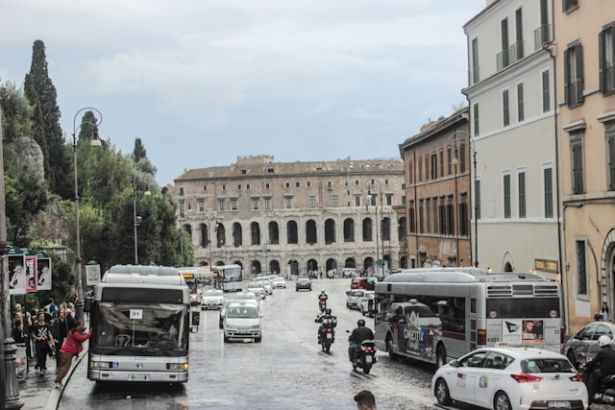
The #40 bus is the express version of the uber-crowded city bus #64. If you take it from its starting point at Termini Station (normally leaving every five minutes), you’ll eventually end up at the Vatican. But, along the way, you’ll tour the historic city center, passing by the Forum before heading onto Piazza Venezia, Largo Argentina (where you can find the remains of Pompey’s temple and columns that date to 80 A.D.) before finally crossing the Tiber. Here, you’ll get a great view of Castel Sant’Angelo, the site of the first tomb of the Emperor Hadrian. Make sure you gaze left to check out Bernini’s Bridge of the Angels. Finalemente, you’ll pull up to Vatican City.

Get your ticket and get on board

A ticket costs you €1 and can be used for up to 75 minutes, including transfers and unlimited hop-on-hop-off action. Traffic can be wild, so find a seat if you can, and get comfortable. Just remember, in Rome, you always board the bus via the front or back doors, but you exit via the middle door.

For more information about getting around Rome by bus or metro, read our article on Getting around Rome.

One safety note: Beware of pickpockets and strange, sudden commotions (distraction anyone?). If you keep your wallets and passports close, you should have no trouble enjoying the—nearly—free ride.

Vatican bonus: Visit St. Peter’s Basilica for free once you get dropped off in Vatican City.

Popularity: 24% [?]

Paris tip: The Louvre for free!

Tuesday, June 17th, 2008

No trip to Paris is complete without a visit to the world-famous Louvre museum, home to the Mona Lisa, Venus de Milo, and much more. Tickets aren’t exactly cheap (admission ranges from €6 to €13, with cheaper prices offered from 6 p.m. to 9:45 p.m. on Wednesdays and Fridays), but the creme de la creme of the museum world opens its doors for free on the first Sunday of each month! (The Musée d’Orsay and the Rodin Museum offer free admission on the first Sunday of each month as well).

Cheapos heading to the city of light in the near future are in for another chance opportunity: on July 14th, Bastille Day, the Louvre offers free admission as well. What better way to celebrate the French Revolution than by admiring some of the nation’s finest art for free?

Check the Musée de Louvre’s site for additional opportunities for a prix-free art fix.

Popularity: 24% [?]

Europe’s night trains: The pleasures; Germany’s newest; how to book

Monday, June 16th, 2008

Night trains in Europe

Nicky Gardner and Susanne Kries of hidden europe magazine report for EuroCheapo on the pleasures and value of European night trains:

Do you know Tczew? Perhaps not. It’s an unexciting sort of spot. Poland, top right, more or less. We had never imagined that we might enjoy a leisurely breakfast of caviar, crackers, and coffee at Tczew. Sitting in a Russian railway carriage, which lingered for an hour or two in Tczew. Waiting for a connection perhaps? Who knows. Night trains are like that.

The pleasures of the night train

Night trains are extraordinary. They rattle past factories and canals, disturb the deer that graze at the forest edge in the evening. In the wee small hours of the night, they screech round sharp curves in some foreign town. A listless child stirs in her sleep in a house next to the railway tracks, while last night’s unwashed crockery trembles on the scullery table. And then the train is gone, an emissary from another world, and silence returns to the unnamed town. Night trains get to places that other trains never reach.

Night trains are the stuff of poetry, but they can also be extraordinarily good value. There is something undeniably civilized about being able to sip a good malt whisky in the evening, as the night train from London to the Scottish Highlands weaves its way out through the northern suburbs of the metropolis. Supper on the train and then to bed in crisp clean linen to awake in the morning as the train climbs up onto Rannoch Moor. Book well in advance, choose the right day, and you can even travel from London to the Scottish Highlands for £l9 (yes, that’s less than $40).

Germany’s new night trains

The Deutsche Bahn, Germany’s national rail network, capitalizes on its location bang in the middle of Europe to run the continent’s most extensive network of night train services. Revamped for the 2008 season, the trains are quiet, comfortable and often a great value. Trains head from Copenhagen or Prague to Basel in Switzerland, from Amsterdam to Milan or Vienna, and dozens of other connections across Europe.

The comfort of the night train is a quiet retort to the frenzy of modern air travel. They’re also an antidote to the breakneck speed of the fastest daytime express trains. Why not try one next time you visit Europe?

Booking a night train

“Special fares apply” says the admonition in the Thomas Cook European Rail Timetable, a monthly publication that is the bible for all savvy rail travelers in Europe. That might imply hefty surcharges. But no, night trains are often cheaper than daytime services. From Switzerland to Denmark overnight in a couchette from just €49 cannot be matched by any discount airline or day train. Choose carefully, and you can travel overnight between European cities in a comfortable sleeping berth for €69.

Most European night trains use a global price system with one all-in charge covering both the train fare and the fee for on-board accommodation. Holders of Eurail and other passes don’t often secure great advantage. The best value all-in fares that Europeans buy locally may cost little more than the supplements that pass holders must pay to secure a couchette or bed. It’s a market which rewards travelers who book well in advance, committing them to traveling on a specific day. Find out more about German night trains, now marketed under the “City Night Line” banner, at www.nachtzugreise.de.

This article is the second of a guest series of summer postings by the editors of hidden europe magazine. Check out the magazine for regular features on European rail travel.

Popularity: 30% [?]