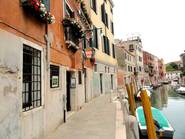
Get ready to walk-and-roll in Venice.
Walking
Walking in a car-free city, it turns out, is a real treat. In a city consisting of winding streets, over 100 canals, and countless bridges, the most reliable mode of transportation is by foot. With map in hand, walking is a fun way to discover this jigsaw puzzle of a town. Luckily, Venice is a relatively small place. Walking between its sites and shops poses more of a logistical challenge than a physical one.
Pick up a map, head off, and keep your sense of humor. You will get lost. When you do, keep your eyes out for the tiny tourist-friendly arrows painted onto buildings, pointing out the way to "Rialto" or "San Marco."

Let the signs point the way!
When asking directions, locate the campo (or piazza) nearest your desired location. Venetians don't do street names, but they sure as heck know their campos. Once you've found the campo closest to your destination, you'll get close enough to ask for more specific directions.

A vaporetti station along the Grand Canal.
Vaporetti
Venice runs its public ferries, or vaporetti, up and down the Grand Canal, providing locals and tourists alike an easy way to move around.
The #2 will be your vaporetto of choice, as it stops at all the main spots. The #1 makes local stops, even though it is referred to as "accellerato" and can sometimes be out-walked. When arriving into the train station, you'll note that you can take the ferry in either direction. Take the ferry heading off to the left, as it's faster, more direct, and more interesting.
Tickets cost €7 and vaporetti leave every 10 to 20 minutes. You can buy tickets at the station, at tobacconists, and newsstands. Just look for the Actv sticker. A one-day pass is available for €20, and a two-day pass runs €30. For more information, visit the ACTV website or check out the EuroCheapo blog for a post about vaporetti savings.

A gondola ride is touristy, expensive and memorable.
Gondolas
Yes, they're touristy. Yes, they're expensive. But, c'mon, admit it: when you planned your trip to Venice, you imagined riding in one of those distinctive Venetian boats known as gondolas. Expect to pay €80 for up to 40 minutes and €40 for each additional 20 minutes until 8 p.m. After 8 p.m., you'll shell out €100 for the first 40 minutes and €50 for each additional 20 minutes.
Activities bearing the EuroCheapo stamp of approval are seldom this pricey, but gondolas are an archetypically romantic, downright fabulous thing. If anything in Venice is splurgeworthy, gondolas certainly are. Check out Gondola Venezia online for more information.
For a less romantic experience, you can take a gondola ferry. Gondola ferries are used by tourists and Venetians alike. They leave from several stations around the city and are used by locals who can't be bothered to make the trek to one of the three bridges over the Grand Canal. The ferries cost €0.50, but because they are privately run, often by old families, the prices can fluctuate.
Visiting Venice for those with disabilities
The whole canal-bridge-boat scene makes the city a bit of a challenge for disabled visitors, to say the least. The APT tourist office staff provides a list of wheelchair-accessible lodging and also publishes a free map outlining wheelchair-friendly routes on each of the city's islands.
More information about accessibility can be found at the Venice City Web site.
Related posts from our blog
All photos © EuroCheapo.com